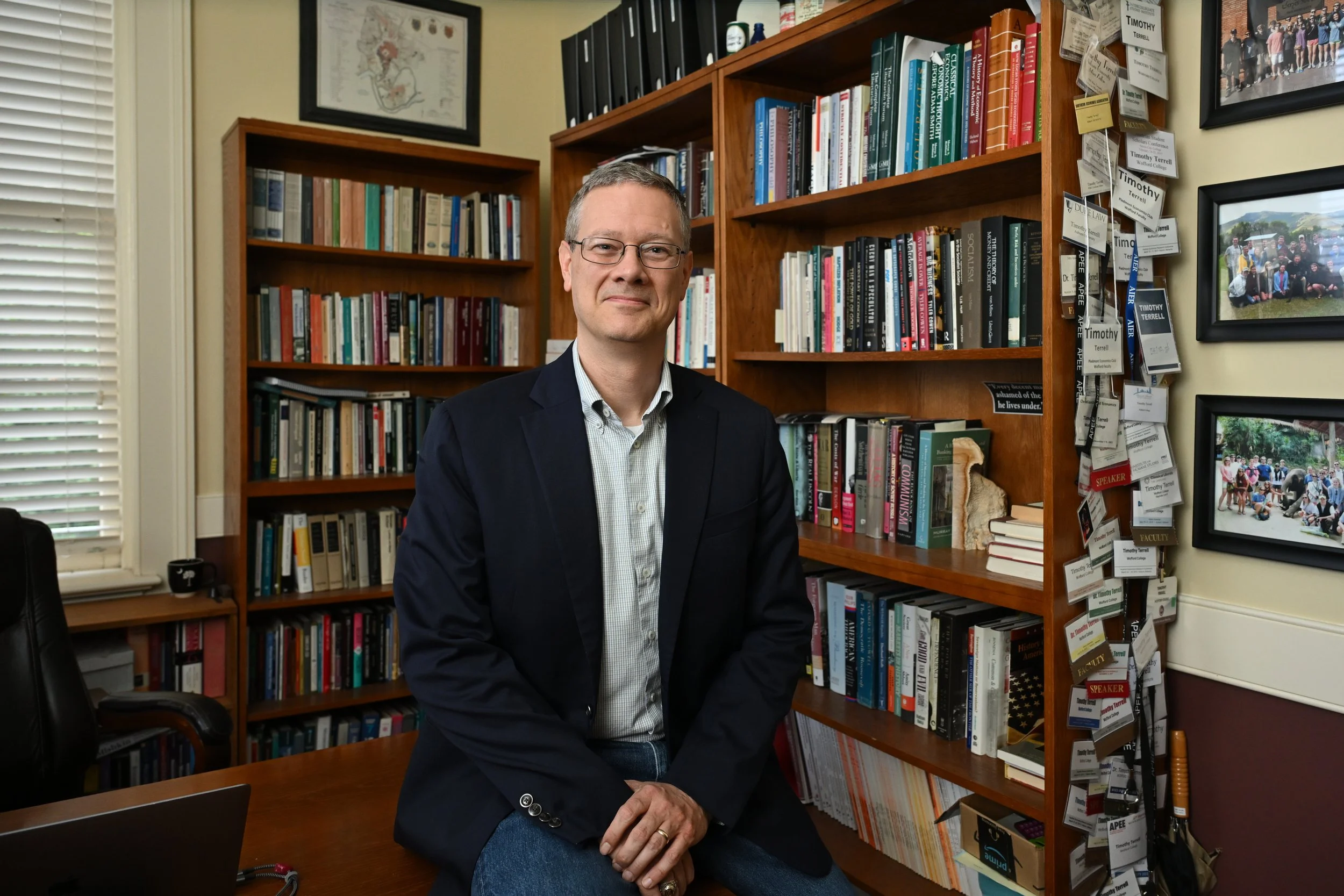
T.B. Stackhouse Professor of Economics, Wofford College
Teaching and Research on Markets and Society
Timothy Terrell has been on the faculty at Wofford College since 2000, where he is T.B. Stackhouse Professor of Economics. He teaches principles of economics, environmental economics, public finance, regulation, American economic history, and other courses.
He is also a senior fellow at the Mises Institute and serves as Senior Associate Editor of the Institute’s Quarterly Journal of Austrian Economics and an associate editor of the Journal of Libertarian Studies. Dr. Terrell is the 2026 Böhm-Bawerk Visiting Research Fellow at the Mises Institute. His research includes work on environmental regulation, property rights, and the ethics of market systems. He posts occasionally at MarketsWork and The Machen Seminar.
Dr. Terrell earned a B.S. and M.A. in economics at Clemson University (1994, 1995) and a Ph.D. in economics at Auburn University (1998).
Wofford Students:
Scam alert: Some students have received emails under Dr. Terrell’s name inviting them to participate in some kind of remote interdisciplinary internship. That is not Timothy Terrell. The emails are not from his Wofford email address. Call his office or stop by in person if you want to verify something that seems to have come from him.
“The processes peculiar to economic life in a free society make evident the fundamental superiority of the spontaneous order over the commanded order.”
– Wilhelm Röpke
Featured Publications
Terrell, Timothy D. 2026. “Calculation and Environmental Policy: Lessons from Human Action.” Chapter 14 in The Influence and Significance of Human Action after 75 Years. Auburn, Ala.: Mises Institute.
Terrell, Timothy D. 2021. “Review of Restoring the Promise: Higher Education in America, by Richard K. Vedder.”Quarterly Journal of Austrian Economics 24, no. 2: 360–367.
Terrell, Timothy D. 2020. “Carbon Flux and N- and M-Shaped Environmental Kuznets Curves: Evidence from International Land Use Change.”Journal of Environmental Economics and Policy 10, no. 2: 155–74.